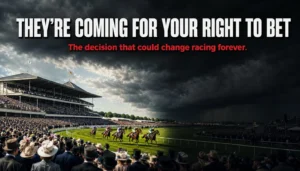
Tomorrow morning a group of people in a boardroom in London will make a decision that has nothing to do with going conditions, draw bias or the Classic generation, and yet it will affect every single person who has ever placed a bet on a British horse race. The Gambling Commission board meets on the 7th of May 2026 to decide the future of affordability checks, a policy that sounds bureaucratic and distant right up until the moment you realise what it actually means. It means that before you can bet on the Derby, the Grand National or any race in between, your bookmaker may be legally required to ask you for bank statements, payslips and financial documents to assess whether you can afford the wager you are about to place. Not if you lose heavily over time. Not if there are signs of problem gambling. Before the bet.
Before a single penny changes hands.
The British Horseracing Authority has been raising the alarm about this for months and the language has grown sharper as the decision point has approached. Greg Swift, the BHA’s director of communications, described a recent meeting with government officials as testing and challenging, and said that racing had become more forceful precisely because its warnings were not being heard. More than 400 figures from across the sport, racecourse executives, trainers, owners and senior officials, signed an open letter to Lisa Nandy, Secretary of State for Culture, Media and Sport, warning that the policy would do lasting damage to the sport and calling for a pause before any implementation. These are not fringe voices. These are the people who run British racing.
The financial stakes are enormous. Racing generates more than four billion pounds for the British economy and supports over 85,000 jobs across training yards, racecourses, breeding operations and the wider supply chain. A significant portion of that income flows directly from betting, through the levy system that funds prize money, racecourse development and the grassroots of the sport. The BHA has made clear that affordability checks, if introduced in their current form, would damage levy income, media rights revenue and sponsorship simultaneously. Racing does not merely have a sentimental attachment to betting. Racing and betting are structurally intertwined in a way that no other sport in Britain can match.
The most compelling evidence against this policy is already visible in the data. A report published by the International Federation of Horseracing Authorities found that unique customer visits to unlicensed gambling sites taking bets on British racing had risen by 522 per cent over a three year period. The black market is not a theoretical future problem. It is already here, already growing and already siphoning money away from the regulated industry that funds the sport. A Betting and Gaming Council survey found that 65 per cent of bettors would not provide the required banking documents if asked. That is not 65 per cent of problem gamblers. That is 65 per cent of ordinary racing fans who would rather take their money to an offshore site with no regulation, no consumer protection and no levy contribution than submit to a process they regard as intrusive and disproportionate. The irony is devastating. A policy designed to protect gamblers would drive the majority of them towards unregulated operators where no protection exists at all.
Racing has already absorbed a significant financial blow from the April 2026 increase in Remote Gaming Duty, which rose from 21 per cent to 40 per cent in a single step. The consequences are already manifesting. Major operators have cut marketing budgets, reduced sponsorship commitments and scaled back the advertising investment that brings new audiences to the sport. A further layer of regulatory friction on top of that tax increase is not a marginal concern. It is an existential one for smaller racecourses, for prize money at lower levels and for the trainers and stable staff whose livelihoods depend on a healthy betting market.
The government was warned. It was warned before the tax increase and it was warned before the affordability check pilots began producing inconsistent results across credit reference agencies. The BHA’s pilot work found that different credit agencies produced different outcomes for the same individuals, which means the policy in its current form cannot be described as frictionless in any honest assessment of the evidence. The commitment made by a previous government that checks would only be introduced if they were truly frictionless has not been honoured and racing knows it.
Tomorrow’s board meeting may not produce an immediate announcement that changes everything overnight. Regulatory processes rarely work that way. But the direction of travel matters and the decision taken in that boardroom on the 7th of May will signal whether the Gambling Commission intends to listen to the most compelling sport specific evidence presented against a gambling policy in a generation, or whether it intends to press ahead regardless. For everyone who loves horse racing, who bets on it, who works in it and who follows it, the answer to that question matters more than any Classic result this season. Follow Romping Home Racing for free daily tips and all the racing news that matters.
Romping Home Racing will be watching the flat season unfold. If you are looking for a bookmaker to follow we recommend Star Sports, one of Britain’s most trusted independent bookmakers and proud supporters of Romping Home Racing. Head over and get set up at Star Sports.
Horse racing involves risk. Bet responsibly, only bet what you can afford to lose. RHR selections are for informational and entertainment purposes only. 18+ only. For gambling support visit BeGambleAware.org or call 0808 8020 133.
www.rompinghomeracing.com — Viewed Through A Sharper Lens. Built On Intelligence.