

There’s a version of horse racing that lives entirely on the surface. Form figures, a name you half recognise, a going description, a headline price. Most people read a racecard the way they’d skim a menu, quickly, on instinct, looking for something familiar. Romping Home Racing was built on the belief that the real story is almost never on the surface. It’s underneath, in the pattern nobody bothered to check, and that’s exactly where the four Angles live.
The first is the simplest to explain and the hardest to spot without pulling years of data apart. Some jockeys and trainers just click. Not in a soft, sentimental way, in a cold, repeatable one. Put the same rider on the same yard’s horses at the same track often enough, and the numbers either back up the chemistry or they don’t. Standout Combos exists because most punters back the horse and forget to ask who’s steering it, and where. When a pairing has quietly out-performed everyone else at a specific course, time and time again, it’s worth knowing before the stalls open, not after.
The second angle starts somewhere a long way from the racetrack, in the breeding. A horse’s sire tells you something about what it was built to do, long before its own form does. Some stallions throw offspring that come alive at a certain trip, generation after generation, regardless of which yard they end up in. Bred For The Trip goes looking for runners who haven’t proven it themselves yet, lightly raced at the distance, or simply overlooked, but whose sire’s record at that exact trip is too strong to be coincidence. It’s a bet on inheritance showing up before the form book catches up.
Then there’s the horse everyone’s already seen win, just not recently, and not at this mark. Ratings rise and fall for reasons that have nothing to do with whether a horse can still do what it once did. A promising run, a couple of quiet ones, a handicapper’s decision, and suddenly a proven winner is being treated like an also ran. Winning Rating tracks exactly this: horses dropping back to, or below, a mark they’ve already won off, with a settling-in period since that win rather than an instant reaction. It’s less a discovery than a memory, reminding the market of something it’s already forgotten.
The fourth angle is about surface, and it’s the one most easily missed because going descriptions look interchangeable until you actually run the numbers. Some horses are transformed by soft ground, or turf, or a particular course’s unique texture, in ways that never show up cleanly in a simple form line glancing across mixed conditions. The Going Suits goes deep into a horse’s history at today’s exact going and today’s exact trip, and only speaks up when the pattern is genuinely strong, not a hunch, a real, repeated edge on this specific underfoot.
None of these four angles are trying to replace judgement. They’re trying to surface what’s already true in the data but invisible to a normal read of the card, the kind of pattern that takes years of results and a stubborn refusal to accept “probably” as an answer. When two or more angles land on the same horse in the same race, that’s not RHR trying harder to sell you something. It’s two independent methods, built for entirely different reasons, arriving at the same name by accident. That’s the moment worth paying attention to.
Every angle gets its own colour, and that’s not just decoration either. Standout Combos runs in orange, Bred For The Trip in gold, Winning Rating in green, The Going Suits in blue, the same four colours, everywhere, on every part of the site, so that once you’ve learned them once you never have to relearn them again. Open the Angles page on any given day and the first thing you’ll see is a running count of each colour, how many Standout Combos are live today, how many Bred For The Trip, how many Winning Rating, how many The Going Suits. A quick temperature check on how busy the day is before you’ve read a single horse’s name.

From there the page breaks down course by course. Tap a track and it opens out into every qualifying angle running there that day, still carrying its colour, with a simple toggle between a fully detailed view, the sire’s record, the rating history, the jockey and trainer’s numbers together, and a stripped back list view for when you just want the name, the time, and the tag.
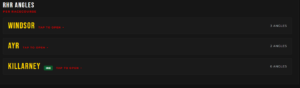
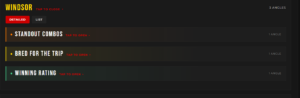
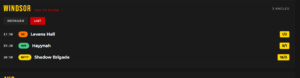
But the real test of a system like this isn’t whether it looks good sitting still on a page, it’s whether it holds up in the middle of a busy racing afternoon, when you’re trying to get to the start of a race in seconds, not minutes. That’s why the same four colours follow you straight onto the RHR racecards themselves. Next to any race time you’ll see a small coloured tag, SC in orange, BFTT in gold, WR in green, TGS in blue, telling you, before you’ve even opened that race, exactly which angle or angles are in play and for which horse. A red RHR TIP tag means something different again, that’s the single premium selection for the day, sitting apart from the four data driven angles rather than replacing them. And running across the top of today’s card, RHR Next quietly counts down to whichever qualifying race is coming up soonest, so nothing gets missed in the rush between races.
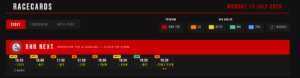
The colours don’t stop when the racing does, either. When one of the four Angles actually wins, that’s not left to sit quietly in a results table, it goes out to Instagram as a short video of the horse crossing the line, dropped into a template carrying the exact same colour as the angle that flagged it. A Bred For The Trip winner goes out in gold, a Standout Combos winner in orange, a Winning Rating winner in green, a The Going Suits winner in blue, so even with the sound off, scrolling past in a feed, the colour alone tells you which method found that winner before you’ve read a word of the caption. It’s the same principle as the RHR racecard tags, just turned outward: the receipts, in the same four colours as the claim.

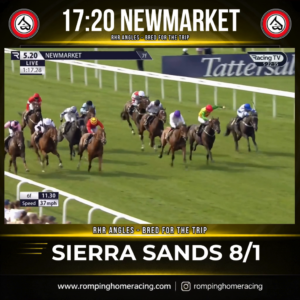
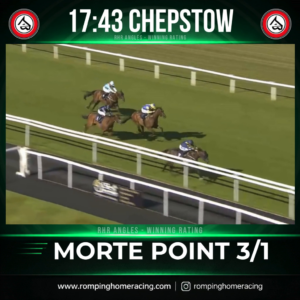
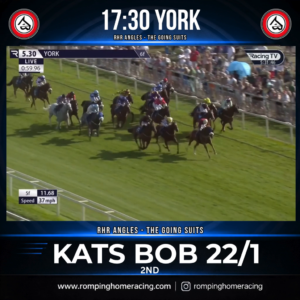
None of this is complicated once you’ve seen it once. That’s rather the point. A colour system only earns its keep if it means something the first time and still means the exact same thing the fiftieth time, no re reading, no second guessing, just a glance and a tag and you already know what you’re looking at. The four Angles were built to find something the surface of a racecard was never going to show you. The colours were built so that once RHR has found it, you never have to go looking for it twice.
We don’t live in one place either, and it isn’t meant to. The RHR racecards and the full Angles breakdown, course by course, are on rompinghomeracing.com every single day, updated as each meeting is worked through rather than dumped all at once the night before. Instagram is where the shorter version plays out, the winning moments, the colour coded results, the odd longshot worth remembering, all posted as they happen rather than gathered up for a weekly highlight reel. Between the two, the site is where you go to see the thinking, and the page is where you go to see it pay off. Follow along on Instagram @rompinghomeracing, and you’ll never be far from whichever colour is about to matter next.
If you’re backing any of today’s picks make sure you’re set up with Star Sports before the first race. It’s who we use, it’s who we recommend and new customers get £20 in free bets when they bet £40 – Get Started Here
All prices quoted are correct at the time of publishing and are subject to change. We recommend checking with your bookmaker for the latest odds before placing any bets.
www.rompinghomeracing.com – Viewed Through A Sharper Lens. Built On Intelligence.
Horse racing involves risk. Bet responsibly – only bet what you can afford to lose. RHR selections are for informational and entertainment purposes only. Prices correct at time of publishing, always check with your bookmaker before placing any bets. 18+ only. For gambling support visit BeGambleAware.org or call 0808 8020 133.