
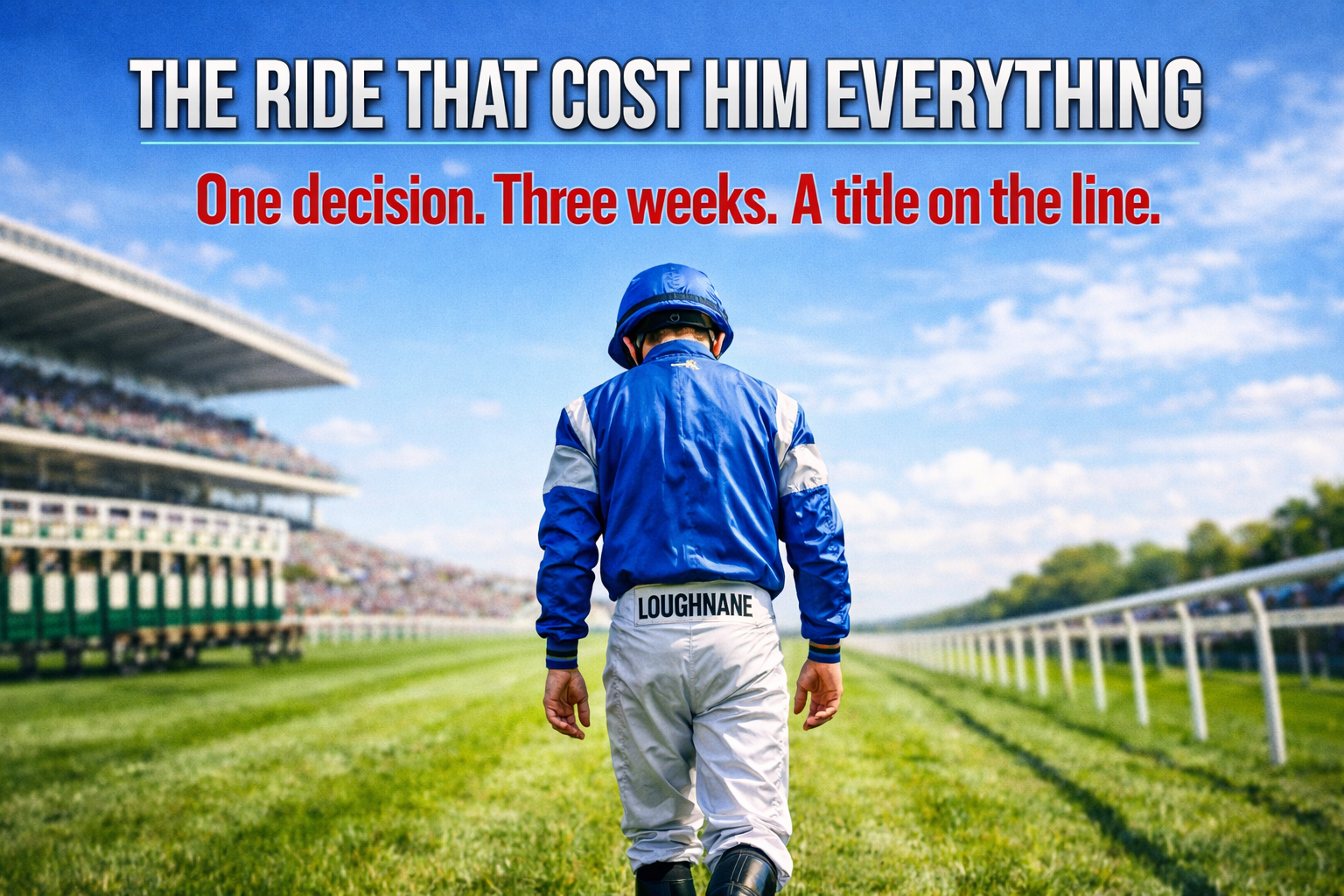
There is a moment at every racecourse, in every stable yard, in every weighing room, where instinct and authority collide. Usually it passes without consequence. At Southwell on Thursday evening, for Billy Loughnane, it did not.
The facts are straightforward enough. Loughnane’s mount Beelzebub received a kick behind the stalls before the final race on the card and was withdrawn by the racecourse veterinary surgeon, who deemed the horse to be lame. Loughnane rode him back from the start. Stewards convened an inquiry, interviewed the rider, the BHA veterinary officer, and the racecourse vet, and concluded that in doing so he had acted against the instructions of the veterinary surgeon. The verdict was 21 days for improper riding. The ban runs from April 9 to April 30.
Horse welfare sits at the absolute core of this story, and it has to. The rules that govern veterinary authority at British racecourses exist for good reason. When a horse is withdrawn on veterinary advice, that decision is made by a qualified professional whose sole responsibility in that moment is the animal’s wellbeing. It is not a suggestion. It is not open to interpretation. And riding a withdrawn horse, regardless of how sound he appears to the naked eye cuts directly against that principle. The sport has worked hard to place horse welfare front and centre of everything it does, and those standards have to apply consistently, to every jockey, at every track, in every race on the card no matter how inconsequential it might seem.
The complication, and the reason this story refuses to sit neatly on one side of the argument, is what happened next. Trainer Dave Loughnane, no relation to Billy was categorical in his response. His team trotted Beelzebub up twice under the jockey and found him completely sound. They trotted him again in front of the owners and again back in the stable yard. The horse, in the trainer’s view, was one hundred per cent. Nobody, he insisted, explicitly told Billy not to ride him back. The yard has made clear they will explore every possible avenue when it comes to an appeal.
So here is where it gets genuinely difficult. If the horse was sound and the trainer is adamant he was, then was the veterinary withdrawal the right call in the first place? And if it was the right call, was a 21-day ban a proportionate response to a young jockey acting on what he saw in front of him? These are questions racing will have to wrestle with, because the answers matter well beyond this one incident at a midweek all weather fixture.
What is not in question is the price Loughnane is now paying. He is twenty years old, the holder of the 21st century record for winners in a calendar year after an extraordinary 2025 season, and second favourite for the 2026 champion jockey title behind Oisin Murphy. The three weeks he sits out encompass Newmarket’s Craven meeting and Newbury’s Greenham Classic trial fixtures where riding arrangements for the season’s biggest races are quietly but decisively locked in. Murphy and his rivals will be out there every day, accumulating, building. Loughnane will not.
He returns on May 1, the opening day of the Guineas meeting at Newmarket, as grand a stage as the Flat season offers for a comeback. If anyone can walk back into that environment and immediately remind the sport of what it is missing, it is him. But the question of whether this enforced absence proves to be the turning point in a championship that runs until November will only be answered with time.
What happened at Southwell was, in the end, a collision between a young man’s instinct and a set of rules designed to protect animals that cannot speak for themselves. The sport’s rules came down hard. Whether you think that was right or wrong may depend on who you ask. What nobody can dispute is that Billy Loughnane is now paying a very heavy price for one ride back from the stalls.
Follow Romping Home Racing for free data driven picks and all the stories that matter from British and Irish racing.
www.rompinghomeracing.com – “viewed through a sharper lens. Built on intelligence”