
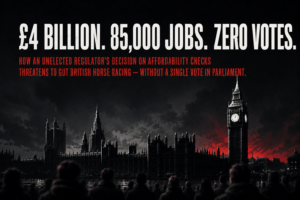
This morning, after months of delay, the Gambling Commission finally confirmed what British racing has spent the best part of two years warning would be a disaster. Financial risk assessments, the sanitised name for what everyone in this industry simply calls affordability checks, now have a binding framework and a schedule. Lose more than £125 in thirty days, or £500 across a year, and you will be quietly checked against publicly available records. Lose more than £1,000 in a single day, or £2,000 over three months, and your bank’s own credit data gets pulled to decide whether you are allowed to keep having a bet. Read those numbers again. A few pounds a week on the horses is now enough to get you flagged. This was never about catching problem gamblers. This is about treating every single ordinary punter in this country as a suspect until proven otherwise, and racing is going to pay for it with people’s jobs.
Nobody in this sport is against protecting people who are struggling. That was never the argument, no matter how many times the regulator pretends otherwise. The argument, made consistently and in public by every serious voice in this industry, is that these checks were promised to be frictionless and have never once been shown to actually work that way. Two full pilot phases. Credit reference agencies coming back with different answers for the exact same customer. A board that paused its own timetable in May because even the regulator wasn’t confident in its own evidence. And then, this morning, confirmation anyway, with barely a backward glance at everything that pilot data actually showed.
Here is what racing stands to lose, and these are not scare numbers pulled from nowhere. Over four hundred of the most senior figures in this sport, trainers, owners, jockeys, MPs from both sides of the House, signed an open letter this year warning that this policy threatens a relationship between racing and betting that has existed for more than three hundred and fifty years. The Jockey Club’s own estimate puts the cost to racing at over a quarter of a billion pounds across the next five years. The BHA’s own figures show betting turnover on racing already down close to seven per cent in a single year, down over sixteen per cent against just two years ago, and that is before today’s confirmation adds a formal, binding layer on top of everything operators have already been doing informally in anticipation of it. Arena Racing Company, who run some of the best loved and most community rooted courses in the country, have already recorded a £280 million fall in digital betting turnover at their own tracks. This is not a hypothetical future. This has already been happening, and today’s decision accelerates it.
Now put a face on those numbers, because that is what actually gets lost in a policy debate conducted entirely in spreadsheets. British racing supports something in the region of eighty five thousand jobs. Stable staff who are up before dawn every single day of the year, whatever the weather, for a wage that was never generous to begin with. Farriers, vets, transport drivers, racecourse catering staff, the woman on the tote window at your local track who has worked there for twenty years and knows half the regulars by name. The BHA has already warned that up to a thousand stable staff jobs are at direct risk from the fall in betting revenue that funds this sport from top to bottom, through the Levy, through media rights, through sponsorship that dries up the moment a betting brand’s own commercial case for being involved in racing stops adding up. These are not City boardroom jobs that can absorb a downturn and carry on regardless. These are rural jobs, often the only significant employer in a small town built around a racecourse. When people talk about affordability checks as a technical regulatory tweak, they are talking about something that ends up landing directly on people who had absolutely no say in creating this policy and no ability to lobby against it the way a well funded operator can.
And here is the part that should make every single person reading this genuinely angry, not just concerned. Punters do not stop betting when they get pushed out of the regulated market. They go somewhere else. They go to unlicensed, offshore operators who ask no questions, provide no protections, contribute not a penny in Levy or tax, and answer to absolutely nobody in this country if something goes wrong. One report this year suggested the black market has more than tripled in size since 2019, and every pound that moves from a regulated bookmaker into an unregulated one is a pound that no longer flows back into the sport, and a punter who has just lost every single consumer protection they used to have. Racing’s own leadership has said plainly that this is the very opposite of consumer protection. It takes people who were betting safely and pushes a meaningful number of them somewhere genuinely dangerous, and calls it progress.
What makes this whole process so hard to stomach is not just the decision itself, it is how it was arrived at. The BHA has publicly asked the Gambling Commission to release the evidence its own board used to reach this conclusion. That request was refused. A senior figure at the BHA described government meetings on this issue as testing and frustrating, characterised by a sense that only one side of the argument was ever being properly heard. This is a policy that will shape the future of Britain’s second most popular sport, and it has been decided entirely by an unelected regulator, with no vote in Parliament, no meaningful public scrutiny of the evidence behind it, and a track record of dismissing the industry’s own data as unreliable while refusing to publish its own. One senior figure in racing summed up what a lot of people in this sport have been quietly thinking for a long time: the regulator cannot be allowed to mark its own homework when the stakes are this high.
It would be dishonest to write this without saying plainly that the Gambling Commission does not see it this way at all. Their position, stated repeatedly and in public, is that these checks will never limit or cap what anyone can spend, that the vast majority of accounts will never trigger any kind of check at all, and that the checks are specifically designed to protect people already in serious financial difficulty rather than to inconvenience the ordinary weekend punter. They point to pilot data showing the overwhelming majority of checks happening invisibly, using only data that is already held, with no document requests and no impact on anyone’s credit score. That is their case, and it deserves to be stated fairly rather than dismissed, because this is genuinely a live and contested argument, not a settled one.
But racing has heard that reassurance before, and racing has watched its own turnover fall anyway while that reassurance was being repeated. The people who actually work in this sport, who get up in the dark to look after horses that will never make anyone rich, who keep small rural racecourses alive, who have built a livelihood around something this country has loved for over three centuries, deserve better than a policy imposed on them by a regulator that will not show its working. British racing did not create this problem. It is being asked to pay for it anyway, and today, that price just became official.
www.rompinghomeracing.com – Viewed Through A Sharper Lens. Built On Intelligence.
Horse racing involves risk. Bet responsibly – only bet what you can afford to lose. RHR selections are for informational and entertainment purposes only. Prices correct at time of publishing, always check with your bookmaker before placing any bets. 18+ only. For gambling support visit BeGambleAware.org or call 0808 8020 133.